

Ether.fi Cash Review
Crypto Card Review
ETH holders and DeFi natives outside the US who prioritise non-custodial control, tax-efficient spending, and compounding wETH cashback.
Overview
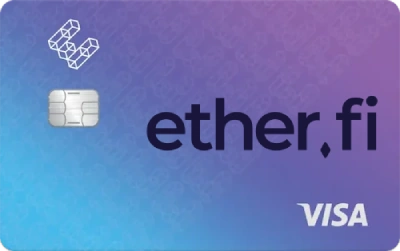
Ether.fi Cash is a non-custodial DeFi crypto card built for ETH holders and DeFi participants who want to spend without selling their assets. Running on the Visa Signature network with free top-ups, zero spending fees, and 2–3% cashback in wETH, it offers one of the most cost-efficient fee structures in this comparison — and one of the few cards where your assets continue generating yield while you spend.
The card’s defining feature is Borrow Mode: rather than selling ETH to fund your card balance, you borrow against your staked ETH position. Your wETH continues compounding while the borrowed amount covers your spending — a structure designed specifically for long-term ETH holders who do not want to trigger a taxable disposal event every time they make a purchase.
A $40 refundable physical card deposit, Apple Pay and Google Pay support, and daily limits up to $100,000 round out a package aimed squarely at DeFi-native users outside the US. UK availability via FCA licensing is expected in September 2026, expanding the card’s footprint into a major market.
Best suited for: ETH holders and DeFi participants outside the US who want to spend against their ETH position without selling, while earning wETH cashback on every purchase.
Why Consider This Card?
Best For
ETH holders and DeFi natives outside the US who prioritise non-custodial control, tax-efficient spending, and compounding wETH cashback.
Key Advantage
Non-custodial — funds stay in your own Gnosis Safe multi-sig wallet
Things to Know
Not available to US residents at launch (no confirmed US timeline)

Ether.fi Cash is a non-custodial DeFi crypto card built for ETH holders and DeFi participants who want to spend without selling their assets. Running on the Visa Signature network with free top-ups, zero spending fees, and 2–3% cashback in wETH, it offers one of the most cost-efficient fee structures in this comparison — and one of the few cards where your assets continue generating yield while you spend.
The card’s defining feature is Borrow Mode: rather than selling ETH to fund your card balance, you borrow against your staked ETH position. Your wETH continues compounding while the borrowed amount covers your spending — a structure designed specifically for long-term ETH holders who do not want to trigger a taxable disposal event every time they make a purchase.
A $40 refundable physical card deposit, Apple Pay and Google Pay support, and daily limits up to $100,000 round out a package aimed squarely at DeFi-native users outside the US. UK availability via FCA licensing is expected in September 2026, expanding the card’s footprint into a major market.
Best suited for: ETH holders and DeFi participants outside the US who want to spend against their ETH position without selling, while earning wETH cashback on every purchase.
PART 2 — AFTER PROS/CONS
(Paste into the main body content area after the pros/cons table)
Borrow Mode: The Feature That Sets Ether.fi Apart
Every other card in this comparison operates on the same fundamental model: deposit crypto, convert to spendable balance, spend. The conversion is the trigger — and in many jurisdictions, converting crypto to fiat is a taxable disposal event, meaning every top-up generates a potential tax liability.
Ether.fi Cash’s Borrow Mode changes this. Instead of selling your ETH or wETH to fund the card, you borrow against your staked ETH position. Your underlying wETH stays in your wallet, continues compounding staking rewards, and is never sold. The borrowed amount — typically a stablecoin — is used to fund your card balance for spending.
The practical implications are significant for long-term ETH holders:
No forced selling. You access spending power without triggering a disposal of your ETH position. In jurisdictions where crypto-to-fiat conversion is a taxable event, this is a material tax efficiency advantage.
Continued yield accrual. Your staked wETH keeps earning while you spend against it. The effective cost of accessing liquidity is the borrowing rate minus the staking yield — which in favourable conditions can approach zero or even be net positive.
Position preservation. ETH holders who are long-term bullish on ETH price can access spending liquidity without reducing their exposure. If ETH appreciates during the borrowing period, the full upside accrues to your still-intact position.
Borrow Mode is not for everyone — it requires understanding collateralisation ratios, liquidation risk if ETH price drops significantly, and active position management. But for DeFi-native users already comfortable with these mechanics, it is a genuinely differentiated feature that no other card in this comparison offers.
wETH Cashback: Earning Yield on Your Spending
Ether.fi Cash pays 2–3% cashback in wETH — wrapped ETH that automatically accrues staking yield. This means the cashback you earn does not sit idle: it compounds from the moment it lands in your wallet, growing at the current wETH staking rate.
The promotional rate of up to 10% applies to qualifying early users or specific spending categories — confirm current eligibility in the Ether.fi app, as promotional rates vary by period.
For context across the category:
- Crypto.com offers up to 5% cashback, but requires $40,000+ in CRO staked to reach the top tier — and CRO carries its own price risk
- RedotPay offers up to 3% on the Solana card variant
- Bybit offers up to 10% but requires high VIP trading volume on the exchange
Ether.fi’s 2–3% base cashback — available without staking a platform token, without exchange account requirements, and paid in an asset that itself generates yield — is the most accessible high-quality cashback structure in this comparison for non-platform users.
The one consideration: cashback is paid in wETH, not USD. If ETH price declines, the dollar value of your cashback declines with it. For users who are already long ETH, this is a non-issue — the cashback simply adds to their position. For users who want cashback in a stable currency, this introduces a variable they need to be comfortable with.
Fee Structure: The Cleanest in the Category
Ether.fi Cash charges no top-up fee and no spending fee. The only recurring fee is a 1% FX conversion charge for cross-currency purchases and a 2% ATM withdrawal fee. There is no annual fee, no monthly fee, and no inactivity fee.
This makes Ether.fi’s all-in cost the lowest of any card in this comparison for regular spenders:
| Transaction type | Ether.fi cost | Tevau cost | Crypto.com cost |
|---|---|---|---|
| Top-up $500 | $0 | $5 (1%) | $5 (1%) |
| Domestic spend $500 | $0 | $0 | $0 |
| Foreign currency spend $500 | $5 (1% FX) | $6 (1.2% FX) | Up to $15 (3% FX) |
| Total (foreign spend) | $5 | $11 | $20 |
For a user spending $2,000 per month in foreign currencies, Ether.fi’s 1% FX fee costs $20/month versus up to $60/month on Crypto.com’s 3% rate — a $480 annual difference before cashback is factored in. Add 2–3% cashback on that $2,000 spend ($40–$60/month in wETH) and Ether.fi produces a net positive return on spending for active users.
Spending Limits and Tiers
Ether.fi Cash operates a tiered limit structure based on verification and account level:
| Tier | Daily limit | Monthly limit |
|---|---|---|
| Standard | $30,000 | $30,000 |
| Higher tier | $100,000 | $100,000 |
The $30,000 standard daily limit is competitive — significantly higher than Bybit’s $5,000–$15,000 and Crypto.com’s $10,000–$25,000 at comparable tiers. The $100,000 top tier covers most high-volume personal spending use cases, though it falls below RedotPay’s $1,000,000 and Tevau’s $3,000,000 for truly high-volume requirements.
Geographic Coverage and UK Expansion
Ether.fi Cash is available globally excluding the US at launch. UK availability is expected with FCA licensing in September 2026 — a significant market addition that will expand the card’s reach into one of the largest crypto user bases in Europe.
For Southeast Asian, European, and Latin American users, the card is available now. The US exclusion is consistent with most cards in this category given the regulatory complexity of crypto card programmes in that market.
Who Should NOT Get Ether.fi Cash
You are not an ETH holder or DeFi participant. Ether.fi’s core features — Borrow Mode, wETH cashback — are designed around ETH as the primary asset. Users who hold primarily USDT, BTC, or other assets will not benefit from the card’s defining capabilities. Cards like Tevau or KazePay are better fits for stablecoin-primary users.
You are not comfortable with DeFi mechanics. Borrow Mode requires understanding collateral ratios, liquidation thresholds, and position management. If these concepts are unfamiliar, the simpler custodial card model is less risky.
You need more than $100,000 daily. Ether.fi’s $100,000 daily cap at the highest tier will constrain very high-volume users. RedotPay and Tevau offer higher limits.
You want cashback in a stable currency. wETH cashback is subject to ETH price movements. Users who want USD-equivalent cashback should consider Crypto.com at higher tiers or Bybit for fiat-denominated rewards.
You are based in the US. Ether.fi Cash is not available to US residents at the time of this review.
You need ATM access regularly. The 2% ATM fee with no free monthly allowance makes frequent cash withdrawals costly. Cards with a free ATM tier — like Crypto.com or Bybit — are more cost-effective for cash-dependent users.
How Ether.fi Cash Compares to Similar Cards
| Ether.fi | SafePal | Crypto.com | |
|---|---|---|---|
| Top-up fee | Free | 0.6% | 1% |
| Spending fee | Free | Free | Free |
| FX fee | 1% | Undisclosed | Up to 3% |
| Daily limit | $30,000–$100,000 | $10,000 | $10,000–$25,000 |
| Custody model | Non-custodial | Non-custodial | Custodial |
| Cashback | 2%–3% wETH | None | Up to 5% CRO |
| Stake required | No | No | Yes (for cashback) |
| Physical card | $40 refundable | Free | Free (with stake) |
| Apple Pay | ✅ | ✅ | ✅ |
Ether.fi and SafePal are the two non-custodial cards in this comparison. Ether.fi adds cashback and free top-ups at the cost of a $40 refundable deposit for the physical card. SafePal offers the lowest top-up fee and Swiss banking infrastructure but no cashback. For reward-focused users, see our Best Crypto Cards for Rewards guide.
How to Get Started with Ether.fi Cash
- Download the Ether.fi app on iOS or Android
- Create an account and complete KYC verification
- Connect your self-custody wallet holding ETH, wETH, USDC, USDT, or BTC
- Choose your spending mode — direct top-up or Borrow Mode against your staked ETH
- Fund your card balance via your connected wallet (no top-up fee)
- Add to Apple Pay or Google Pay immediately
- Order the physical card with a $40 refundable deposit if needed
For Borrow Mode, additional setup is required to establish your collateral position within the Ether.fi protocol — detailed instructions are available in the Ether.fi app.
Pricing & Fees
| Virtual Card Cost | Free |
|---|---|
| Physical Card Cost | $40 (refundable deposit) |
| Annual Fee | Free |
| Top-up Fee | Free |
| Minimum Top-up | $40 |
| FX Fee | 1% |
| ATM Withdrawal Fee | 2% |
| Crypto Conversion Fee | Unknown |
| Card Replacement Fee | $20 |
| Inactivity Fee | Free |
| Transaction Fee | Free |
| Refund Fee | Free |
Limits
| Per-Transaction Limit | $30,000 to $100,000 (depends on card tier) |
|---|---|
| Daily Spending Limit | $30,000 to $100,000 (depends on card tier) |
| Monthly Spending Limit | $30,000 to $100,000 (depends on card tier) |
| ATM Daily Limit | $250/withdrawal; max 3 attempts per rolling 24 hours |
| ATM Monthly Limit | $250/withdrawal; max 3 attempts per rolling 24 hours |
| Top-up Min. Limit | $5 |
| Top-up Max. Limit | Unlimited |
Card Features
| Virtual Card | Yes |
|---|---|
| Physical Card | Yes |
| Apple Pay | Yes |
| Google Pay | Yes |
| ATM Withdrawal | Yes |
| Rewards Program | Yes — 2%–3% cashback; promo up to 10% |
| Cashback Token | wETH |
| Special Benefit | Borrow Mode (spend against ETH collateral without selling); Visa Signature benefits (purchase protection, extended warranty, rental insurance) |
| Subscription Rebates | No |
| Earning | Yes — Liquid Vault earns 5%+ APR on idle USDC; wETH cashback compounds via staking |
| Mobile App Controls | Yes (freeze, transaction history, spending controls, multi-member roles) |
| Security Controls | Gnosis Safe multi-sig, non-custodial architecture, real-time notifications |
Customer Care
| Support Channels | In-app help, email, Help Center (help.ether.fi) |
|---|---|
| Response Time | Good — Responsive team; priority support for higher tiers |
| Languages Supported | English, Spanish, Portuguese, Traditional Chinese (help center) |
| Knowledge Base | Yes — help.ether.fi |
| Refund Handling | Cashback reversed on refunded transactions; standard Visa dispute process applies |
| User Reviews | Very positive among early adopters |
| Trust Score | ~3.8/5 (early adopter reviews) |
Order Now
| Card Type | Virtual & Physical ($40 refundable deposit for physical) |
|---|---|
| Min Top-up | $5 |
| Approval Time | Virtual: Instant; Physical KYC approval: Fast (hours to 1 day) |
| Bonus Offer | Various Seasonal Promotion |
| Card Delivery Time | Virtual: Instant; Physical: ~7 days international shipping (user reports) |
| Region Warning | Not available to US residents at launch; UK access available (full FCA licensing expected September 2026); Borrow Mode has liquidation risk |
Pros & Cons
Pros
- Non-custodial — funds stay in your own Gnosis Safe multi-sig wallet
- Up to 3% cashback in wETH (compounds your ETH stack via staking yield)
- Borrow Mode: spend without selling crypto (tax-efficient)
- No annual fee at any tier
- Liquid Vault earns 5%+ APR on idle USDC balances
- Apple Pay and Google Pay supported
- Tax-efficient for long-term holders (borrowing not a taxable event)
- Visa Signature benefits: purchase protection, extended warranty, rental insurance
Cons
- Not available to US residents at launch (no confirmed US timeline)
- Borrow Mode carries liquidation risk if collateral value drops
- $40 physical card issuance fee (refundable deposit)
- 1% FX fee on non-USD transactions
- 2% ATM withdrawal fee
- DeFi complexity may not suit non-crypto-native users
- Newer product with shorter track record than established competitors
- Borrowing rates revert to AAVE market rates when promo ends (2–10% APY)
Final Verdict
Ether.fi Cash is the most technically sophisticated card in this comparison — and for the right user, the most financially efficient. Free top-ups, zero spending fees, 1% FX conversion, and 2–3% wETH cashback combine into a structure where active spenders generate a net positive return on their card use before any asset appreciation is counted. No other card in this category achieves that combination without a staking requirement or platform dependency.
The Borrow Mode feature is genuinely differentiated. For ETH holders who want spending liquidity without forced selling, without triggering tax events, and without reducing their ETH exposure, it solves a problem that no competing card addresses. It is the reason Ether.fi Cash is particularly compelling for DeFi-native users who are already managing collateral positions on other protocols.
The limitations are consistent and clearly scoped: the card is built for ETH holders, runs best when you are comfortable with DeFi mechanics, and is not available to US users. For users outside that profile, the card’s advantages do not translate cleanly. USDT-primary users are better served by Tevau or KazePay. Users who want cashback without ETH exposure will find Crypto.com’s CRO-staking cashback or RedotPay’s Solana cashback more suitable.
For ETH holders outside the US who spend regularly, Ether.fi Cash is the strongest all-round option in the category in 2026. The fee structure, cashback quality, non-custodial model, and Borrow Mode capability combine into a package that is difficult to match.
Apply via UCardCrypto & Get Your Reward
Start your Ether.fi Cash application through UCardCrypto and unlock a guaranteed UCard reward for completing the eligible steps.
Compare with another card
User Reviews
No user reviews yet. Used this card? Your review helps other readers.
Write a review
Frequently Asked Questions
What makes the Ether.fi Cash card different from other crypto cards?
Ether.fi Cash lets you spend directly from your self-custodied ETH and liquid staking positions without giving up yield or moving assets to a centralised platform.
Do I need to unstake my ETH to use the Ether.fi card?
No. The Ether.fi Cash card lets you spend against your staked ETH position without unstaking, preserving your yield while enabling everyday spending.
What cryptocurrencies does Ether.fi Cash support?
Ether.fi Cash primarily supports ETH, USDC, USDT and BTC. It is most relevant for users with significant ETH or liquid staking token positions.
Is the Ether.fi Cash card non-custodial?
Yes. Ether.fi Cash maintains a non-custodial approach — your assets remain under your control until you spend, consistent with the broader Ether.fi protocol philosophy.
Who is the Ether.fi Cash card best suited for?
Ether.fi Cash is best suited for DeFi-native ETH holders who want to spend crypto in daily life without exiting their staking position or moving funds to a centralised exchange.