

RedotPay Review
Crypto Card Review
High-volume spenders and traders needing the largest transaction limits with Apple Pay + physical card coverage in 100+ countries.
Overview
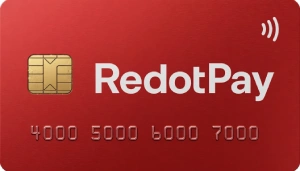
RedotPay is a Hong Kong-based crypto debit card built for high-volume spenders. It runs on the Visa network, supports 20+ cryptocurrencies for top-up, and offers a $1,000,000 daily spending limit with full KYC — the highest verified limit of any card in this comparison after Tevau. With coverage across 158 countries and acceptance of assets including BTC, ETH, USDT, USDC, SOL, BNB, XRP, TON, TRX, and SUI, it is one of the most versatile multi-asset spending cards available to non-US crypto holders.
The card charges a 1% top-up fee and a 1% spending fee, with a 1.2% FX conversion fee for cross-currency transactions. While the fee structure is not the cheapest — particularly for users who want zero spending fees — the combination of high limits, broad crypto support, and Apple Pay and Google Pay compatibility makes it a strong option for users who regularly move meaningful amounts.
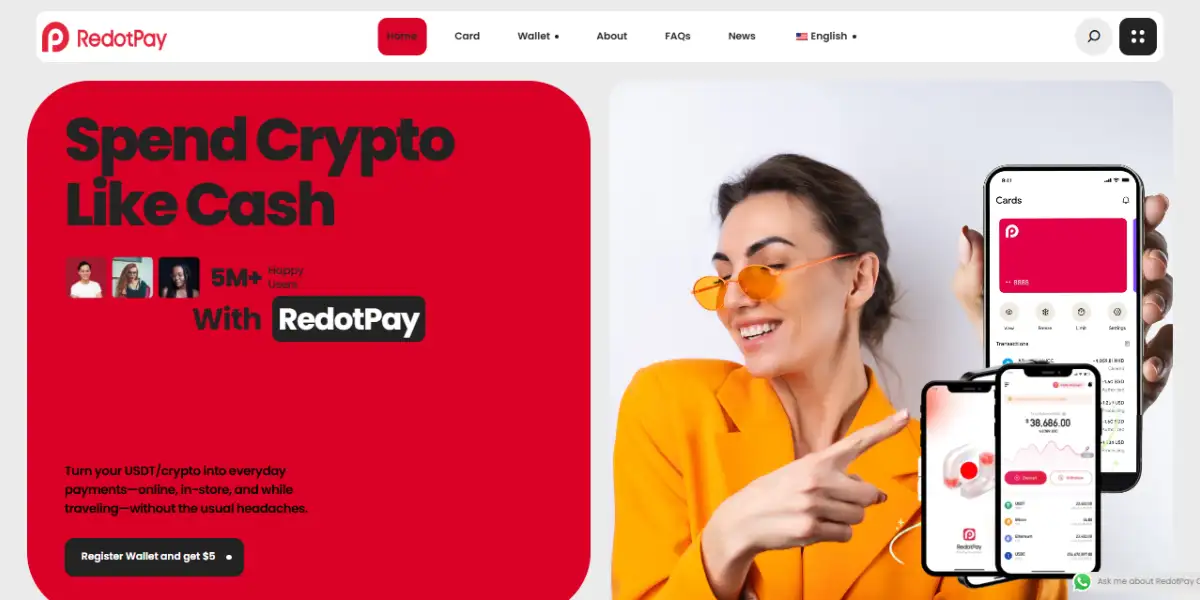
A physical card is available for $100, and a sign-up bonus of $5 is offered to new users. Cashback of up to 3% is available for Solana card users, and full KYC plus AML verification is required for all accounts.
Best suited for: high-volume crypto spenders holding a wide range of assets who need a single card that handles large daily transactions across 158 countries.
Why Consider This Card?
Best For
High-volume spenders and traders needing the largest transaction limits with Apple Pay + physical card coverage in 100+ countries.
Key Advantage
Industry-leading $100K per-transaction and $1M daily limits
Things to Know
$10 virtual card + $100 physical card issuance fee
Who RedotPay Is Really Built For
RedotPay’s design choices make it clear this card targets a specific type of user: someone who holds multiple cryptocurrencies, spends regularly in large amounts, and needs a card that keeps up without hitting a daily ceiling.
The $1,000,000 daily and monthly spending limit is the most immediate signal. Most cards in this category cap standard users at $10,000–$50,000 per day, requiring premium verification or staking to unlock higher amounts. RedotPay’s limit is available with standard full KYC — no token staking, no exchange account, no tiered subscription required.
The 20+ supported cryptocurrencies for top-up is the second signal. Beyond the standard USDT and USDC, RedotPay accepts BTC, ETH, SOL, BNB, XRP, TON, TRX, SUI, and Sonic — covering the major holdings of most active crypto traders and DeFi participants. This means fewer conversion steps before loading the card, which matters when assets are spread across different networks and wallets.
For users whose portfolio goes beyond stablecoins, RedotPay removes the friction of converting everything to USDT before spending — a step that cards like Tevau and KazePay require since they only accept USDT and USDC for top-ups.
Understanding the Fee Structure
RedotPay charges fees at two points: a 1% top-up fee when you deposit crypto, and a 1% spending fee on each transaction. The FX conversion fee is 1.2% for cross-currency purchases.
For a $500 spend in a foreign currency: $5 top-up fee + $5 spending fee + $6 FX fee = $16 total, or 3.2% effective cost. This is higher than zero-spending-fee cards like Tevau (2.2% all-in for the same transaction) but comparable to PokePay with a similar stacking structure.
The question is whether the premium is justified by RedotPay’s capabilities. For a user who needs $1,000,000 daily limits and multi-asset top-up support, the answer is often yes — those features are not available at a lower price point. For a user who only holds USDT and spends under $10,000 per day, a zero-spending-fee card like Tevau is the more cost-efficient choice.
The $5 sign-up bonus partially offsets the initial cost for new users, though it is a one-time credit rather than an ongoing benefit.
Cashback: The Solana Card Opportunity
RedotPay offers up to 3% cashback for users who opt into the Solana card variant. This is one of the more competitive cashback rates in the category — comparable to Ether.fi Cash’s 2–3% wETH cashback, while Tevau currently offers no rewards programme.
The Solana cashback is tied to using SOL as your top-up asset via the Solana network. If your holdings include SOL and you are comfortable with the Solana network for transfers, this is a genuine earning opportunity that changes the effective cost calculation meaningfully. At 3% cashback against a 3.2% effective fee cost, the net cost of spending on RedotPay approaches zero for Solana users.
For users not holding SOL or not using the Solana network, standard cashback does not apply and the card competes purely on its limit and asset-support advantages.
Supported Networks and Top-Up Flexibility
RedotPay accepts top-ups via ERC20, TRC20, BSC, and Arbitrum, with additional network support across its 20+ supported assets. This is broader than most cards in the category and covers the primary networks used for USDT transfers globally.
TRC20 (Tron) is typically the cheapest and fastest network for USDT transfers, and its support on RedotPay means users can top up efficiently without paying high Ethereum gas fees. For BNB and BSC-native assets, BSC support eliminates the need to bridge before depositing.
The specific network availability for each asset is worth confirming in the RedotPay app before transferring, as network support can vary by asset and region.
Geographic Coverage and Exclusions
RedotPay is available in 158 countries — slightly narrower than the global coverage offered by Tevau and KazePay, but still broad enough to cover most of the world outside sanctioned and heavily restricted jurisdictions.
Key exclusions include the US, Mainland China, and Singapore. Singapore’s exclusion is worth noting specifically for Southeast Asian users — RedotPay is not available for Singapore residents despite its regional presence and Hong Kong base.
For users in Malaysia, Indonesia, Vietnam, the Philippines, Thailand, and most of Europe and Latin America, the card is available without restriction.
Who Should NOT Get RedotPay
You want zero spending fees. RedotPay’s 1% spending fee stacks on top of the 1% top-up fee. For users who prioritise fee minimisation over limit size, Tevau or KazePay offer zero spending fees with comparable onboarding.
You are based in Singapore, the US, or Mainland China. RedotPay is not available for residents of these regions.
You only hold USDT and spend under $50,000 per day. If your top-up needs are limited to USDT and your daily volume is well under RedotPay’s limit, the fee premium is not justified. Tevau delivers a cheaper experience for standard-volume USDT spenders.
You want a cheap physical card. At $100, RedotPay’s physical card is mid-range in price. Bybit’s physical card costs $5, making it significantly cheaper if physical card access is your primary goal.
You need the lowest possible FX fee. At 1.2%, RedotPay’s FX fee is reasonable but not the lowest. PokePay charges 1% FX, and Ether.fi charges 1% — marginally cheaper for heavy cross-currency users.
How RedotPay Compares to Similar Cards
| RedotPay | Tevau | KazePay | |
|---|---|---|---|
| Top-up fee | 1% | ~1% | 1.8%–2.2% |
| Spending fee | 1% | Free | Free |
| FX fee | 1.2% | 1.2% | 1%–3% |
| Daily limit | $1,000,000 | $3,000,000 | $50,000–$250,000 |
| Supported cryptos | 20+ | USDT, USDC only | USDT, USDC only |
| Physical card cost | $100 | $100 | $100–$150 |
| Apple Pay | ✅ | ✅ | ✅ Virtual only |
| Cashback | Up to 3% (Solana) | Points | 2% (unconfirmed) |
RedotPay’s 20+ crypto support is its clearest advantage over Tevau and KazePay, both of which are stablecoin-only. Its daily limit is lower than Tevau’s $3,000,000 but higher than KazePay’s $250,000 premium tier. For a full comparison across all USDT cards, see our Best USDT Debit Cards guide.
How to Get Started with RedotPay
- Download the RedotPay app on iOS or Android
- Register with your email address
- Complete full KYC — government-issued ID, selfie, and AML verification (required for all accounts)
- Select your preferred card variant (standard or Solana cashback)
- Top up with your chosen cryptocurrency via ERC20, TRC20, BSC, Arbitrum, or other supported networks
- Add your virtual card to Apple Pay or Google Pay
- Order a physical card for $100 if needed — allow 7–21 business days for delivery
Note: Full KYC and AML verification is mandatory for all RedotPay accounts, including virtual card access. There is no minimal-KYC virtual card tier as offered by some competitors.
Pricing & Fees
| Virtual Card Cost | $10 |
|---|---|
| Physical Card Cost | $100 |
| Annual Fee | Free |
| Top-up Fee | 1% |
| Minimum Top-up | $1 |
| FX Fee | 1.2% |
| ATM Withdrawal Fee | 2% |
| Crypto Conversion Fee | 1% |
| Card Replacement Fee | Repurchase new card |
| Inactivity Fee | Free |
| Transaction Fee | 1% |
| Refund Fee | >€1 or 0.05%; $50 chargeback fee |
Limits
| Per-Transaction Limit | $100,000 |
|---|---|
| Daily Spending Limit | $1,000,000 |
| Monthly Spending Limit | $1,000,000 |
| ATM Daily Limit | $3,750 |
| ATM Monthly Limit | $50,000 |
| Top-up Min. Limit | $1 |
| Top-up Max. Limit | Unlimited |
Card Features
| Virtual Card | Yes |
|---|---|
| Physical Card | Yes |
| Apple Pay | Yes |
| Google Pay | Yes |
| ATM Withdrawal | Yes |
| Rewards Program | $5 Sign up bonus |
| Cashback Token | up to 3% for Solana card users |
| Special Benefit | RedotPay Credit (crypto-backed credit line); P2P transfers; high spending limits |
| Subscription Rebates | No |
| Earning | Yes — USDT & USDC Earning yield Daily |
| Mobile App Controls | Yes (freeze, lock card, transaction notifications) |
| Security Controls | PIN protection, biometric auth, real-time transaction monitoring |
Customer Care
| Support Channels | In-app chat, Help Center, email, Telegram, Discord |
|---|---|
| Response Time | 1–3 days for complex issues (KYC re-verification may take 3–5 days) |
| Languages Supported | English, Arabic, French, Portuguese, Simplified Chinese, Spanish |
| Knowledge Base | Yes — helpcenter.redotpay.com |
| Refund Handling | $50 chargeback fee; 3–6 month resolution timeline for disputes |
| User Reviews | Mixed — high-volume users mostly satisfied |
| Trust Score | 3.2/5 (Trustpilot) |
Order Now
| Card Type | Virtual & Physical |
|---|---|
| Min Top-up | $1 |
| Approval Time | Virtual: Minutes to hours after KYC; Physical: Standard shipping |
| Bonus Offer | $5 USDC welcome reward for new users for card rebate |
| Card Delivery Time | Virtual: Near-instant post-KYC; Physical: ~5–14 business days (varies by country) |
| Region Warning | US, Mainland China, Singapore and several other countries excluded; physical card delivery also restricted in some regions |
Pros & Cons
Pros
- Industry-leading $100K per-transaction and $1M daily limits
- Wide crypto support: BTC, ETH, USDT, USDC + 20+ altcoins across multiple networks
- Apple Pay, Google Pay, Samsung Pay all supported
- Telegram mini-app for instant USDT top-ups
- Both virtual and physical cards available
- Available in 100+ countries
- Large help center with multilingual support articles
- $5 USDC welcome reward for new users
Cons
- $10 virtual card + $100 physical card issuance fee
- 1% crypto conversion + 1.2% FX fee stacks quickly for international use
- No cashback or rewards program
- $50 chargeback fee with 3–6 month dispute resolution timeline
- Custodial model — funds can be frozen for compliance checks
- Trustpilot score ~3.2/5; support can be slow on complex issues
- US, Mainland China, Singapore and other regions excluded
- Physical card delivery restricted in some countries
Final Verdict
RedotPay occupies a clear and well-defined position in the USDT card market: it is the best option for multi-asset crypto holders who need high daily limits, broad cryptocurrency support, and genuine global reach. The $1,000,000 daily limit, 20+ supported top-up assets, Apple Pay and Google Pay compatibility, and up to 3% Solana cashback combine into a package that no single competing card fully replicates.
The fee structure is the honest trade-off. The 1% spending fee stacks with the 1% top-up fee to produce a 2–3.2% effective transaction cost depending on currency. For users who spend frequently in large volumes, the absolute fee amount grows proportionally — a $10,000 transaction costs $200–$320 in fees versus $110–$120 on a zero-spending-fee card. Whether that premium is acceptable depends on whether RedotPay’s limit and asset-support features are genuinely necessary for your use case.
For USDT-only holders spending under $50,000 per day, Tevau delivers a cheaper and simpler experience with higher absolute limits. For users who want the broadest multi-chain top-up flexibility, KazePay supports eight blockchain networks across USDT and USDC. For users who want cashback without the spending fee, Ether.fi Cash offers 2–3% wETH rewards with zero transaction fees.
RedotPay is the right card when the full breadth of its capabilities — limits, asset variety, and cashback potential — aligns with how you actually spend.
Apply via UCardCrypto & Get Your Reward
Start your RedotPay application through UCardCrypto and unlock a guaranteed UCard reward for completing the eligible steps.
Compare with another card
User Reviews
No user reviews yet. Used this card? Your review helps other readers.
Write a review
Frequently Asked Questions
What is the maximum transaction limit on RedotPay?
RedotPay supports up to $100,000 USD per transaction — one of the highest limits available among crypto debit cards, making it suitable for high-volume spenders.
How many cryptocurrencies does RedotPay support?
RedotPay supports 20+ cryptocurrencies for top-up including BTC, ETH, USDT, USDC, SOL, BNB, and more.
Does RedotPay require KYC verification?
Yes. Full KYC verification is required before card issuance. RedotPay operates under regulated financial compliance standards.
What network does the RedotPay card run on?
RedotPay operates on the Visa network, giving it global acceptance at millions of merchants in 180+ countries.
Who is the RedotPay card best suited for?
RedotPay is particularly well suited for high-volume crypto users who need large transaction limits and multi-currency support in a single card.