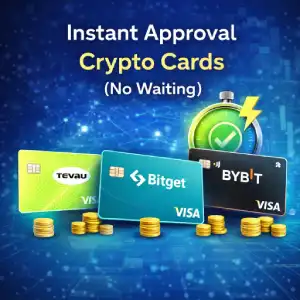
Short answer: no legitimate crypto card is truly “no KYC”. Every card we review asks you to verify your identity before it issues a card. Card issuers work under anti-money-laundering rules, so they have to confirm who you are first. What does differ is how much each provider asks for and how quickly it reviews you. Below, the cards we review are ranked from the lightest identity check to the heaviest, using only what each provider publishes.
What “no KYC” offers usually mean
- A step before KYC, not a card without it. Some apps let you sign up or deposit crypto first. Ether.fi, for example, accepts crypto deposits before verification, but the card itself needs verification before you can use it.
- Out-of-date information. Lists of “no KYC cards” are often old. The providers in this guide all require identity verification today.
- Sellers you cannot hold to account. A card offered without any identity check is unlikely to come from a regulated issuer. If it is blocked, you may have no one to ask for your money back.
Crypto cards ranked by the easiest and fastest KYC
We rank by what each provider publishes: a published review time first, then the fewest verification steps. Where a provider publishes nothing, we say so.
| # | Card | What the provider asks for | Review time | Apply |
|---|---|---|---|---|
| 1 | Crypto.com Visa Card | Full legal name, a government-issued ID and a selfie. Some users can verify through their bank instead of uploading documents. | A few hours to a couple of business days | Apply |
| 2 | Ether.fi Cash | Phone number, a government-issued ID, a selfie liveness check and your address (sometimes proof of address). A $10 deposit is required before card verification. | Most reviews within 48 hours | Apply |
| 3 | Tevau | Full legal name, date of birth and an ID card or passport. More information may be requested. | Not published | Apply |
| 4 | RedotPay | Personal details, a government-issued ID, a face scan, your residential address and a short questionnaire. Sometimes a personal statement, due within 14 days. | Not published | Apply |
| 5 | Bybit Card | Identity verification and your residential address. The card has stricter identity requirements than a standard Bybit account, so you may have to verify again. | Not published | Apply |
| 6 | KazePay | ID, address, a selfie and source of funds. | Not published | Apply |
| 7 | SafePal | A Fiat24 Swiss account: an account NFT, your GPS location, risk questions and a biometric passport or ID. Not available to US persons. | Not published | Apply |
| 8 | PokePay | KYC is required for any card, in tiers. The documents for each tier are not published. | Not published | Apply |
Requirements can change and can differ by country. Check the provider’s app before you start.
How to get through KYC faster
- Use a valid, unexpired passport or national ID card.
- Take a clear photo: the whole document visible, readable and not cropped.
- Enter your name, date of birth and address exactly as they appear on your documents.
- If proof of address is requested, use a recent document that shows your full name and address.
Which card should you choose?
If a quick, simple check matters most, start with Crypto.com or Ether.fi Cash, the two providers that publish a review time. Fees, rewards and availability matter more over time, so compare them in our best USDT cards ranking, or start with our best cards for beginners.