

PokePay Review
Crypto Card Review
APAC users, freelancers, and crypto off-rampers seeking an affordable entry-level crypto card with broad platform support and zero ongoing fees.
Overview
PokePay is a low-cost Hong Kong-issued virtual crypto debit card designed for everyday crypto spending. It runs on the Visa network and is accepted in 100+ countries, making it one of the more accessible options for non-US crypto holders who want to spend USDT, USDC, BTC, or ETH without converting to fiat first.
The card stands out for its fast onboarding — a virtual card can be issued in minutes with minimal KYC, and both Apple Pay and Google Pay are supported from day one. There is no monthly or annual fee, which keeps the cost low for occasional spenders who don’t need a high daily transaction volume.
The trade-off is a stacking fee structure: PokePay charges 1% on top-ups and a separate 1% on each spending transaction, creating an effective 2% base cost per purchase before any FX conversion applies. For light users this is manageable, but frequent spenders will feel it compound over time.
Best suited for: crypto users outside the US who want a fast, simple virtual card for online and contactless spending with minimal setup friction.

Why Consider This Card?
Best For
APAC users, freelancers, and crypto off-rampers seeking an affordable entry-level crypto card with broad platform support and zero ongoing fees.
Key Advantage
Virtual card activation from as low as $5 (with promo codes)
Things to Know
Virtual card activation fee of $20 standard (promo codes reduce to ~$5–$7.20)
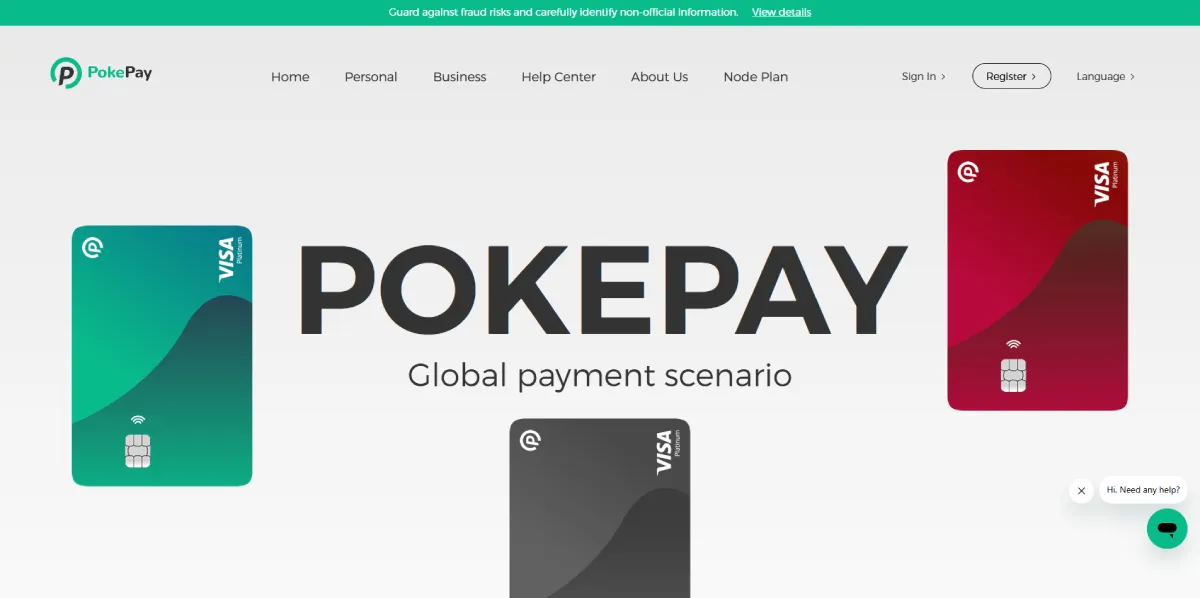
Understanding the Real Cost of Using PokePay
PokePay’s fee structure is straightforward on paper but worth examining in practice. The 1% top-up fee and 1% spending fee are charged separately, which means a single transaction carries a 2% base cost before currency conversion is applied. Add the 1% FX fee for non-base-currency purchases and the effective cost reaches 3% per transaction.
To put that in concrete terms: top up $500 USDT and spend it on a purchase in a foreign currency, and you pay $5 on deposit, $5 on the transaction, and $5 in FX conversion — $15 total on a $500 spend. For occasional purchases this is acceptable. For weekly or daily use, it adds up to a meaningful annual cost that cheaper alternatives avoid.
If fee minimisation is your priority, it is worth comparing PokePay directly against cards that charge no spending fee. Tevau charges approximately 1% on top-ups but zero on spending transactions, and supports far higher daily limits — up to $3,000,000 versus PokePay’s ~$12,500 cap. KazePay also charges zero spending fees with a broader range of supported blockchain networks, making it easier to top up from multiple chains without worrying about network compatibility.
Spending Limits: Know Before You Top Up
PokePay’s daily spending limit of HKD 100,000 (approximately $12,500 USD) is adequate for most consumer use — covering travel expenses, online subscriptions, e-commerce, and everyday merchant purchases. However, it is one of the lower daily caps in the USDT card category.
For users who need to move larger amounts — such as freelancers receiving project payments, remote workers covering business expenses, or traders managing higher volumes — PokePay’s cap will create friction. In those cases, RedotPay is worth a look: it supports up to $1,000,000 per day with full KYC verification, making it the stronger choice for high-volume crypto spenders.
PokePay does not publicly disclose its monthly spending limit, which is worth clarifying with their support team before committing to the card as a primary spending tool.
Who Should NOT Get PokePay
PokePay is a good entry-level card, but it is not the right fit for every user. Consider alternatives if any of the following apply to you:
You spend frequently or in large volumes. The stacking 1% + 1% fee structure is a real cost for high-frequency users. Cards with zero spending fees will save you money over time.
You need a daily limit above $12,500. PokePay’s cap will interrupt regular high-value transactions. If you routinely spend more than this daily, the card will become a bottleneck.
You want cashback or rewards. PokePay has no dedicated cashback programme. If earning on your spending matters to you, Ether.fi Cash offers 2–3% cashback in wETH, and Bybit offers up to 10% for eligible users.
You need a cheap physical card. At $88, PokePay’s physical card is among the most expensive in this category. Bybit’s physical card costs $5, and SafePal’s is free — if you need a physical card, those are significantly more cost-effective entry points.
You rely on specific blockchain networks. PokePay does not clearly document which networks (TRC20, ERC20, BEP20, etc.) are supported for top-ups. This lack of transparency has caused top-up issues for some users who sent assets via an unsupported network. Verify with support before transferring.
You are based in the US, Russia, or Iraq. PokePay is not available in these regions.
How PokePay Compares to Similar Cards
| PokePay | Tevau | KazePay | |
|---|---|---|---|
| Top-up fee | 1% | 1% | 1.8%–2.2% |
| Spending fee | 1% | Free | Free |
| FX fee | 1% | 1.2% | 1%–3% |
| Daily limit | ~$12,500 | $3,000,000 | $50,000–$250,000 |
| Physical card cost | $88 | $100 | $100–$150 |
| Apple Pay | ✅ | ✅ | ✅ Virtual only |
| Cashback | ❌ | Points | 2% rebate |
| KYC (virtual) | Minimal | Minimal | Minimal |
PokePay’s main advantage over Tevau and KazePay is faster onboarding and a lower activation cost for the virtual card. Its main disadvantages are the spending fee and the lower daily limit. For a full ranking of USDT-compatible cards, see our Best USDT Debit Cards guide.
How to Get Started with PokePay
Getting a PokePay virtual card takes under 10 minutes:
- Download the PokePay app on iOS or Android
- Register with your email address
- Complete minimal KYC — typically a selfie and basic identity information
- Pay the one-time $5 virtual card activation fee
- Top up with USDT, USDC, BTC, or ETH (confirm the correct network with support first)
- Add to Apple Pay or Google Pay and start spending immediately
For the physical card, additional full KYC is required and delivery takes 7–21 business days depending on your location.
Pricing & Fees
| Virtual Card Cost | $5 |
|---|---|
| Physical Card Cost | $88 |
| Annual Fee | Free |
| Top-up Fee | Free |
| Minimum Top-up | $0 |
| FX Fee | 1% |
| ATM Withdrawal Fee | 2% |
| Crypto Conversion Fee | 1% |
| Card Replacement Fee | $50 |
| Inactivity Fee | $0 |
| Transaction Fee | 1% |
| Refund Fee | Free |
Limits
| Per-Transaction Limit | 100,000HKD |
|---|---|
| Daily Spending Limit | 100,000HKD |
| Monthly Spending Limit | unknown |
| ATM Daily Limit | HKD 5,000 max.5 withdrawals |
| ATM Monthly Limit | unknown |
| Top up Min. Limit | 0.1 HKD |
| Top up Max. Limit | Unlimited |
Card Features
| Virtual Card | Yes |
|---|---|
| Physical Card | Yes |
| Apple Pay | Yes |
| Google Pay | Yes |
| ATM Withdrawal | Yes |
| Rewards Program | No dedicated cashback program; referral/node program up to 50% commission |
| Cashback Token | No |
| Special Benefit | HK Alipay & WeChat Pay integration; PayPal, Wise, Netflix, Spotify, ChatGPT Plus support; 0% cross-border fee on HK-issued card |
| Subscription Rebates | No |
| Earning | No |
| Mobile App Controls | Yes (one-click card lock, 3DS toggle, combined payment settings) |
| security controls | 3D Secure (3DS), one-click card lock, data encryption, CVV protection |
Customer Care
| Support Channels | In-app chat, email, phone, telegram, FAQ portal |
|---|---|
| Response Time | Within 24 hours (email); variable —fast response speed support |
| Languages Supported | Chinese (primary), English (Traditional Chinese for support) |
| Knowledge Base | Yes — FAQ and guides at pokepay.cc |
| Refund Handling | Standard Visa refund: 3–7 working days (merchant) + 2–4 days Visa network processing |
| User Reviews | Trustpilot 3.7/5; Google Play 3.5/5 (185 reviews, 10K+ downloads); limited independent review history |
| Trust Score | 3.7/5 (Trustpilot); regulated by FINTRAC Canada and VASP Poland |
Order Now
| Card Type | Virtual or Physical |
|---|---|
| Min Top-up | 0.1 HKD min. top-up; virtual card activation from $5 |
| Approval Time | 10 minutes after KYC |
| Bonus Offer | No |
| Card Delivery Time | Virtual: Instant; Physical: 10–30 working days (shipped from Greater Bay Area) |
| Region Warning | HK-issued Visa; restricted jurisdictions apply (US, Russia, Iraq, and others); Steam not supported; iOS app region-limited |
Pros & Cons
Pros
- Virtual card activation from as low as $5 (with promo codes)
- Zero monthly fees, zero annual fees, zero micro-transaction fees
- Accepts USDT, USDC, BTC, ETH for top-up
- Supports Apple Pay and Google Pay
- Works with Alipay, WeChat, PayPal, Wise, Netflix, Spotify, ChatGPT Plus
- Physical card supports global ATM withdrawals and POS payments
- 0% cross-border fees on HK-issued card
- Free card replacement on standard expiry
Cons
- Virtual card activation fee of $20 standard (promo codes reduce to ~$5–$7.20)
- Physical card costs $88–$99 (promotional pricing available)
- 1% recharge fee on all crypto top-ups
- 1% FX fee for non-HKD transactions
- Customer service responsiveness complaints reported (Trustpilot 3.7/5)
- Some major platforms not supported (e.g., Steam)
- iOS app primarily for US/HK region — limited availability elsewhere
- Restricted jurisdictions include US, Russia, Iraq, and other listed countries
Final Verdict
PokePay is an accessible, no-frills crypto debit card that does what it promises: fast virtual card issuance, Apple Pay support, and global Visa acceptance with no monthly fees. For a first-time crypto card user or someone who wants a quick setup without complex onboarding, it delivers a genuinely smooth experience.
The limitations are real, however. The stacking 1% top-up and 1% spending fee creates an effective 2–3% cost per transaction that compounds quickly for regular users. The ~$12,500 daily limit will frustrate anyone moving meaningful volumes. And the absence of any cashback programme means you are paying fees without earning anything back.
PokePay earns its place as a starter card — particularly for users who value speed and simplicity over fee optimisation. But it is worth revisiting your card choice once your spending volume grows or your fee sensitivity increases.
If lower transaction costs are your priority, Tevau charges no spending fee and supports significantly higher daily limits. If you need a higher limit with broader crypto support, RedotPay is the stronger option for high-volume users. And if earning cashback on your crypto spending matters, Ether.fi Cash offers 2–3% in wETH with a comparable onboarding experience.
Apply via UCardCrypto & Get Your Reward
Start your PokePay application through UCardCrypto and unlock a guaranteed UCard reward for completing the eligible steps.
Compare with another card
User Reviews
No user reviews yet. Used this card? Your review helps other readers.
Write a review
Frequently Asked Questions
How much does the PokePay virtual card cost?
The PokePay virtual card costs approximately 20 USDT to open, reduced to around 7.2 USDT with a promotional coupon. There are no monthly or annual fees.
Does PokePay support Apple Pay and WeChat Pay?
Yes. PokePay supports both Apple Pay and WeChat Pay, alongside Alipay, Taobao, and Meituan top-ups — making it one of the few crypto cards that bridges Asian and international payment ecosystems simultaneously.
What cryptocurrencies does PokePay accept for top-up?
PokePay accepts USDT, USDC, BTC, and ETH for card top-ups.
Does PokePay require KYC verification?
PokePay offers tiered KYC. Basic virtual card features are accessible with minimal verification, with higher spending limits unlocked after full KYC completion.
What is the daily spending limit on PokePay?
The daily spending limit is HK$100,000 — approximately $12,500 USD — which covers most everyday use cases comfortably.